Share page


Regular Columns
Review
The state we’re in
Windows of Opportunity
David Sainsbury
Profile Books (£8.99)
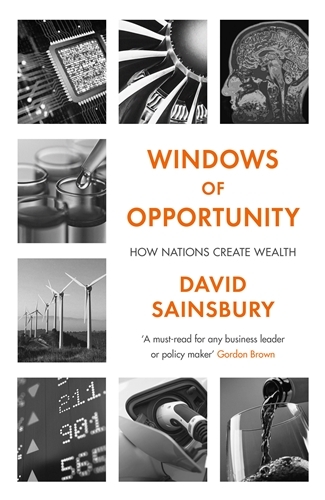
In 2015, the innovation policies initiated by the prior Labour government, promoted by Lord Sainsbury when he was Minister of Science, were terminated by the Conservative government. Sainsbury reckoned that this was largely on the basis of neo-classical growth theory, implying that there were no grounds for government intervention in the promotion of growth, innovation or technical progress. He says his book was inspired by wanting to “lay the basis for more effective policies…to develop a new and realistic production-capability theory of economic growth, one that better represents the observable world, and to which more politicians can sign up to”.
What Sainsbury calls the production-capability school of thought is not new, nor does he claim originality in this. Antecedents include Friedrich List, Alexander Hamilton, Joseph Schumpeter and, more recently, Erik Reinert, whose 2007 book, How Rich Countries Got Rich… and Why Poor Countries Stay Poor, was an inspiration for him. So, the first two chapters contain a compare and contrast analysis of the neo-classical, market-efficiency growth model with the production-capability, market-opportunity dynamic model, the latter of which the author espouses.
This model proposes that innovation leadership in developing high-value-added sectoral activities, usually, but not always, in manufacturing, is the elixir that will propel countries to the top of the wealth ladder.
Chapter 7 involves a cautionary tale of countries falling behind, with the foremost example, alas, being the UK. Sainsbury attributes this mainly to the decline in our share of manufacturing production (but fails to note that this occurred primarily as a consequence of Thatcherite policies in the early 1980s). Instead, he argues: “History shows it was due to a lack of technological and organisational innovation by British firms, which in turn was due largely to the failure of three key British economic institutions: firms’ governance and financing; the national system of education and training; and the national system of innovation.”
Governance, finance, education (especially technical training) and innovation policies are fields in which Lord Sainsbury has great expertise and also much practical and political hands-on experience. Whatever else you may think of the general economic analysis, the last three chapters are well worth reading for their insights, arguments and suggestions about national systems of education and training, national systems of innovation and the role of government in creating wealth.
But what should one make of the broader thesis about replacing the neo-classical growth theory with a productivity-capability approach? In my view, Sainsbury is correct to skewer the former theory as an exercise in sterile mathematics, treating labour and capital as homogenous, and technical progress as largely exogenous to the model. But it is hard to resist some cynical scepticism that a proposition that puts business entrepreneurs, especially manufacturers, at the epicentre of growth would inevitably prove catnip to someone in the author’s position.
Sainsbury provides multiple examples of governments providing help, directly or indirectly, for innovation and growth, especially perhaps in wartime. Indeed, there is an intriguing correlation, which he does not pursue, between innovatory leadership and military prowess.
The exclusion of government from neo-classical growth theory is empirically misguided. There is also an awkward corner, which he fails to tackle adequately. This is that he accepts that the historical record of governments in backing individual firm “winners” has been dismal. Yet he simultaneously argues that governments can, and should, support individual sectors (of industry). What causes the difference between choosing firms (bad) and sectors (good)? Sainsbury even goes so far as to task the government “with adopting the dynamic capability theory of economic growth set out in this book”. Surely, it should not be a role of government to pronounce that theory A is better than theory B.
An odd feature of this book is that, despite being initiated in 2015 and published in 2020, virtually all the figures, tables, examples, etc relate to the period before 2015. There is no mention of Trump, of Making America Great Again, of the populist revolt against globalisation, or of the growing systemic rivalry between the US and China, all of which would seem relevant to the author’s thesis.
That said, it is nicely written and well argued. If I had my way, I would want to make it a required reading in mathematical economics courses since it suggests forcefully that much of what else they are learning has little, or no, historical or empirical basis. Per contra, I would not want business schools to put it on their reading lists, except perhaps for the final three chapters, since it would give their students an exaggerated view of the role of entrepreneurs in our political and economic systems. But no doubt the reverse will occur.
Charles Goodhart
Emeritus professor of banking and finance at the London School of Economics
Making the Financial System Sustainable
Paul G Fisher (ed)
CUP (£80)

Financial revolutions are rarely fought and won on barricades in a blaze of smoke. Instead, there is the slow burn of the alternative theories followed by many years of effort to turn the grinding wheels of global financial regulation. Finance is built on the ideal of stability, it does not see change as the norm, but even in finance there comes a point when change becomes inevitable. Suddenly, you find that the supertanker has turned and it is hard to imagine there was ever a different path.
This book of essays, edited by Paul G Fisher, is evidence of just how far that process has come for sustainable finance. Once at the margins of what was called ethical finance, sustainable finance has captured the regulatory and political levers of our financial system. This has happened at the same time as the man-made effects of climate change have shifted from largely ignored, and often contested, scientific fact to popular belief and now, perhaps – finally – political will. In Europe, 93% of people think that climate change is a serious problem and the financial system is now moving at pace (at least for a supertanker) to catch up.
The essays were written by members of the European Commission’s High-Level Expert Group on Sustainable Finance, whose work and recommendation-laden report has been both highly effective at driving European legislation and very influential around the world. The topics range across the full gamut of change needed, from overall system change to governance and the behaviour of financial firms, from the Just Transition to reform of financial advice.
Each of the essays requires careful study and is rich in both insight and technical detail. This is sustainable finance written for financial professionals and the most striking thing about this book is how the alternative economic thinking is placed front and centre of this work. Just as Mark Carney’s Reith Lectures are causing ripples around the financial and economic world, so this work is embedded in the radical departure from the old gospel of free markets and globalisation as the only road to prosperity and societal well-being.
As the introduction puts it: “The rules of economic conduct and economics as a field of enquiry are not immutable natural laws. They are a set of tools which generate a shared, imagined mental construct which changes over time, and indeed can be changed as we so please.” For a respected senior regulator and finance academic such as Paul Fisher to make this point central to their analysis is something to be celebrated and welcomed.
The book says its primary purpose is to “challenge the assumptions in the underlying model so as to refashion the financial system to be sustainable (ie viable in the long term)” and “embrace the idea of societal utility … in the UN Sustainable Development Goals”.
The essays themselves, in effect, set out a series of blueprints for the internal and external changes that financial firms and the financial system need to make. They outline how to incorporate this new thinking into the day-to-day understanding of how money works and how finance uses money to create a better future. As the book says, 2020 could well be a tipping point for finance, a point of no return that will have wide-reaching consequences for the finance industry. It will be a very necessary shift to make if we are going to be successful in transforming our economy from one based on carbon to one that ceases to accelerate climate change through carbon emissions.
To paraphrase the philosopher Slavoj Zizek, who was speaking slightly tongue in cheek after the financial crisis of 2007-08, it has been easier to imagine the end of the world than the reform of global financial capitalism. Now it seems that the end of the world, or at least the existential threat to modern human civilisation that climate change represents, has made it easier to imagine the transformation of financial capitalism. With luck, it will become something that shapes a necessarily more sustainable society for us all.
Bruce Davis
Founder of Abundance Investments
Kings of Crypto
Jeff John Roberts
Harvard Business Review (£22)
It’s always interesting to read a book on a topic that you know something about, but it’s much more interesting to read a book about people you know something about. When the topic is cryptocurrency and the people range from genuine visionaries through lottery winners and on to carpetbaggers and scammers, it is more entertaining still. This is why I found myself galloping through this comfortably written narrative on the formation and evolution of Coinbase over the course of a single afternoon through several cups of tea.
I don’t remember if it was Confucius, or someone on a management consultant training course I attended about 40 years ago, who said that when there is a gold rush it is the people selling shovels that make the most money. (To be fair, looking at the relative market capitalisation of Wells Fargo and Levi Strauss, one might conclude that in the long run lending people money to buy shovels is a pretty good business, too.)
Most miners fared poorly during the California Gold Rush. The businesses that did best were those that ignored gold in favour of a more profitable resource: the tens of thousands of newcomers pouring across the frontier. In March 1848, the California territory was home to fewer than 800 non-native Americans. By the mid 1850s, there were more than 300,000 of them and it was the merchants making fortunes, not miners.
So what is going on in the cryptocurrency gold rush then? Brian Armstrong, the central character in this enjoyable book, decided not to be a miner, or to sell mining equipment, but to serve those incoming hordes. He did that by creating an exchange that served normal people, not the crypto priesthood. Armstrong was an engineer and, together with the former Wall Street trader Fred Ehrsam, founded Coinbase to provide a place to buy and sell cryptocurrencies easily.
It was a pretty good idea because, as Jeff John Roberts observes at the end of his entertaining and educational book, the cryptocurrency markets are all about speculation. In such a market, it is no surprise that it is the cryptocurrency exchanges that have pole position. The exchanges make money by taking fees on trades placed by its customers whether bitcoin and the like are soaring or tanking.
The idea paid off big time, since Armstrong is now a billionaire and Coinbase is the leading cryptocurrency exchange in the US. Its story gives us insight into the strange journey of bitcoin, Ethereum, Dogecoin and such like but, more importantly, gives us an inkling of where they might be going.
That’s because while the book entertainingly chronicles the fractious (and warring) tribes of cryptocurrency believers – the war between bitcoin’s “big blockers” and “small blockers” brought to mind the never-ending conflict between Swift’s “big-endians” and “little-endians” – it touches on one or two fundamental truths about the longer-term intersecting trajectories of cryptocurrencies and what we might loosely sum up as ‘Wall Street’.
Barry Schuler, the former chief executive of America Online, is quoted observing that, while a great many other industries have seen astonishing disruption in the internet era, financial services have been largely untouched. A thin layer of superhighway gloss has been applied to the creaking infrastructure that is essentially still the same as it was at the dawn of the web.
I strongly agree with Schuler and others quoted in the book that the fintech revolution hasn’t yet happened and that, when it does come, it will come in the form of tokenised digital assets rather than bitcoins. It will also come from a more mature and better regulated marketplace. In this marketplace there will be a more sophisticated and complex value chain in which it is unclear whether either Coinbase or JPMorgan will be the winners. I can’t help but agree with Armstrong’s comments when he says there is a next generation “cryptocompany 3.0” around the corner that none of us has seen yet.
David Birch
A director of Consult Hyperion
The Great British Reboot
Alex Brummer
Yale University Press (£20)
Alex Brummer’s book is a good read, with a clearly argued case. In a nutshell, it says that the UK economy has many strengths, that Brexit is an opportunity as well as a challenge and that – with the right policy approach and mindset – there is a bright future. The tone is generally one of relentless optimism. And there’s nothing wrong with that, particularly given the largely negative vein one finds in much economic commentary. Looking at sectors ranging from higher education to pharmaceuticals, from architecture to gaming, Brummer is reasonably convincing in making the case that there are many good things happening in the UK economy now – Brexit and Covid-19 notwithstanding.
To his credit, he doesn’t for the most part repeat claims that either our membership of the EU overall, or specific EU rules or regulations, have been holding us back. And he accepts that Brexit will have some negative economic consequences, for example for the City of London. Instead, he’s making the broader argument – arguably more political than economic – that after Brexit the UK has “a marvellous opportunity to reboot its economy, its society and its governance”.
In particular, he advocates a much more proactive approach to industrial policy after Brexit. This is hard to argue with, and goes with the grain of current thinking in Westminster and Whitehall. But the devil is in the detail. For example, he argues that the UK should be less open to foreign takeovers of high-growth companies or of firms in strategic sectors. He provides examples of where, in his view, we’ve lost out from allowing them in the past. He believes the government should have more powers, and use them aggressively, to block such acquisitions – as some European governments do. Ironically, we’d be using the opportunity of leaving the EU to become more French.
But when exactly should we block foreign investment, given that Brummer also accepts that sometimes it has benefited British industry? No hard and fast rules are set out, meaning that we’d have to rely on politicians and civil servants. It’s easy enough to get these decisions right with hindsight, but do we trust Whitehall and Westminster to be able to make them looking forward?
Brummer’s approach to the bigger picture is also can-do, with some commendable ambitions that are shared across the political spectrum. These include: more investment in infrastructure, particularly in order to connect parts of the country that have been “left-behind” by growth over the past four decades; better technical and vocational education; improving social mobility; and reducing intergenerational inequalities.
He is correct that Brexit makes these even more important. But none of these challenges is new. The key has always been the ability of politicians and civil servants to address them. It’s hard to argue that our experience of government since 2016 provides evidence that Brexit has delivered a step change for the better. Indeed, the opposite appears to be the case. First Theresa May and now Boris Johnson have presided over a steady erosion of institutional and constitutional norms. The UK’s relatively poor performance, on both health and economic outcomes, during the current pandemic is a further illustration of major structural weaknesses. Why or how Brexit could be the solution to those is lost on me. In that respect, I find it hard to share Brummer’s optimism.
But there are many good ideas here and food for thought for politicians. In the depths of winter, confined indoors, it’s good for us all to be reminded that this country has a lot going for it, and better
times ahead.
Jonathan Portes
Professor of economics at KCL
More from
Regular Columns