Be part of our community
JOIN LIBF FOR ACCESS TO FINANCIAL WORLD
Financial World Archive
Access the FW archive here
Follow us
Data protection
© The London Institute of Banking & Finance 2024 - All rights reserved

Reviews
Weapons of mass persuasion
TITLE
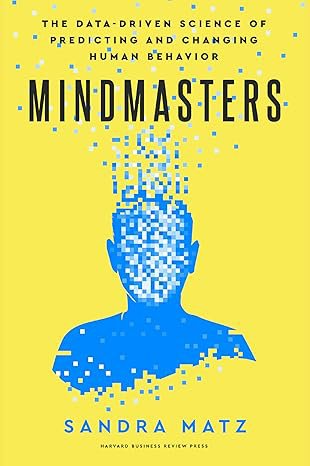
Mindmasters
Author
Sandra Matz
Publisher
Harvard Business Review (£17.69)
We are all aware that the data trails we leave behind online are valuable. We know they are collected, stored, analysed and traded. A glance at the list of cookies on any website reveals a vast ecosystem of data traders feeding on the data crumbs we create so innocently. We are also aware of how much personal information we give to tech giants such as Google and Meta through the plethora of apps we use daily. They know where we are, what we do, with whom we interact and what’s on our mind as we idly scroll through the pictures of cute cats.
What is harder to understand is why this information is so valuable. What do they do with this data and should we be concerned? These are the questions at the core of this book, in which Sandra Matz tries to equip us with the necessary knowledge to have an informed and nuanced opinion on this increasingly urgent topic.
The book explains “how computers can translate seemingly mundane and innocuous information about what we do into highly intimate insights about who we are and ultimately prescriptions of what we should do”. By associating words and increasingly pictures in our posts, locations, movement and frequency of social interactions with archetypal psychological personalities, it is possible to tailor content and multiply its influencing efficacy.
Psychological targeting translates our digital footprint into a prediction of our personality, sexual orientation, political ideology, health and income, with the aim of influencing what we think and feel. Tailoring involves not only altering the selection of topics or products in our feed (as the TikTok algorithm does so well), but also the embedded message (including subliminal) in content, which is adapted to each specific personality type, delivering a much higher hit rate.
Unsurprisingly, improving the efficacy of marketing to make us buy more is the most common use case. However, influencing elections, moulding political sentiment, changing social cohesion and altering more intimate behaviours seem equally achievable. The widespread adoption of AI-powered predictive models enables a scaling up of this approach at greatly reduced cost. We should expect further generalisation of psychological targeting in all domains.
Dystopian though that sounds, this is not an anti-technology book. The author goes to great lengths to showcase the potential beneficial uses of psychological targeting. For example, sharing data signalling depression with mental health professionals rather than with marketing professionals could allow for the design of early intervention systems and significantly improve the treatment of depression.
Paradoxically, though, the section on the potential benefits of using psychological targeting to deliver public goods seems even more disturbing than the idea of using it for private gain. While Matz briefly acknowledges the dangers of using these tools in autocracies, there is little discussion of the incentives for any state authorities, in democracies or otherwise, to abuse their power of manipulation.
The parallel with the debate on nudging and its legitimacy in the public arena deserves a longer look than it is given here. If the idea of governmental authorities considering how to take advantage of the irrationality of the average citizen (for example, changing the default status for organ donation to increase donation rates) is already controversial, are we really ready to accept authorities profiling citizens according to a probabilistic predictive model based on their digital activities?
In the last section of the book, Matz proposes a mixture of public and private initiatives aimed at reforming the data ecosystem to make it work for us and not against us. Data co-ops, stricter competition enforcement to ensure data capture remains fragmented (and thus less useful for profiling) and the right to see other people’s feeds seem interesting avenues, but the challenges of governance, political feasibility and enforcement remain sketchy.
The author makes the subject highly readable and entertaining, while remaining largely informative and credible. In a world increasingly moulded by oligarchy and autocracy, the dangers of mass profiling and opinion manipulation are more and more present. Improving our understanding of the current digital data market structure is going to be essential if we want to achieve reform and attempt to sustain our hard-won democratic freedoms and rights.
Martina Garcia – is a Board Director at Haitong Bank and the former Director of the Centre for the Study of Financial Innovation at LIBF

TITLE
MoneyGPT: AI and the Threat to the Global Economy
Author
James Rickards
Publisher
Penguin (£18.99)
Artificial intelligence is revolutionising finance, as we are reminded on a daily basis. However, it comes with undeniable risks and poses threats that could destabilise the global financial system. There is a real possibility that an AI, or networks of interacting AIs, may trigger bank runs or even worse.
You may well think I’m an inappropriately optimistic techno-determinist, but it seems to me that while there is undoubtedly potential for a wholly AI-powered global financial system to go horribly wrong – which is James Rickards’ basic warning in MoneyGPT – there is also potential for it to support the real economy vastly better.
Recent data from Swiss Re shows that self-driving vehicles had 88% fewer property damage claims and 92% fewer injury claims than average human drivers, and data from Ukraine shows that the hit rate for AI-guided drones is higher than for manually piloted ones. I can’t help but wonder, then, why anyone might think that people can run banks better than bots will. Why would bank customers want to handle their own finances rather than have a super-intelligent personal treasurer do it for them? And why would replacing bank regulators with Terminators lead to worse financial health for the population than the system we have now?
I was puzzled by the book’s title, because GPT, which stands for generative pre-trained transformer, is not a general purpose artificial general intelligence but a class of large language models. These models produce what Rickards calls ‘confabulation’, what AI experts call ‘hallucination’ and what I call ‘bullshit’. This is not a bug but an inevitable side-effect of the way they work.
ChatGPT and its ilk, therefore, work well when the potential damage done by hallucinations is low. If AI makes up rubbish when writing a recipe and tells people to put glue on pizza, the ramifications are limited. On the other hand, errors in a swaps contract or a commercial loan are more worrying. We must, therefore, face up to the risk that AI may start bank runs (and nuclear wars and so forth) and take this into account when deploying the technology.
Predicting such risk is complicated, though, because AI is very different from other technologies. As Arvind Narayanan and Sayash Kapoor note in their recent book AI Snake Oil (PUP, 2024), the advent of true artificial brains will be a new event in human history, and the financial sector, just like every other sector, has no past data that can be used to calibrate predictions. We can certainly scour the trajectories of previous technologies for clues, but it seems unlikely that we can translate those clues, guesses and current anecdotes into anything of strategic value.
Why would bank customers want to handle their own finances rather than have a super-intelligent personal treasurer do it for them?
What can we do to fend off disaster, then? When it comes to managing the risk to the global financial system, Rickards suggests ‘cybernetics’ as the most effective mitigation, and I agree. The Atlanta Fed published an interesting perspective on AI’s role in future risk evaluation and management a while ago, suggesting that robo-regulators will actually enhance risk assessment by using predictive analytics to foresee potential financial threats.
This must be the way forward: using AI insights will help in proactive planning, allowing regulators to better shield the system from black swans and respond quickly to them when they do occur. Rather as computers learned to be better at playing Go than people are, they may learn to be better than people at minimising systemic risks.
The book touches on many issues, ranging from Big Tech censorship and the liberal media to Covid vaccines and climate change, but overall I am not sure that I learned much about the global financial system from it (unlike Rickard’s 2012 book Currency Wars: The Making of the Next Global Crisis). I don’t think I really learned anything about AI from it either, but if you want to frighten yourself on the flight to the Swift International Banking Operations Seminar (SIBOS) in Frankfurt this year, it might be for you.
David G.W. Birch – author, adviser and commentator on digital financial services
TITLE
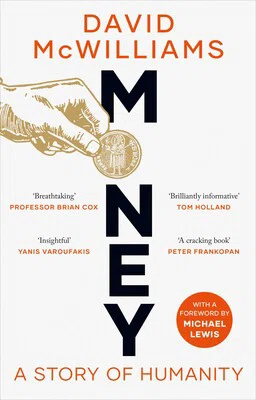
Money: a Story of Humanity
Author
David McWilliams
Publisher
Simon & Schuster (£25)
Money makes the world go round, as they sing in ‘Cabaret’, but it also makes the world move forward, according to economist David McWilliams. His latest book chronicles how ancient Samarians replaced barter with coins based on the value of grain, how the Lydians introduced a gold-backed currency across what is now western Turkey in the seventh century BC, and how the Greeks, followed by the Romans, copied the concept, albeit using silver.
Money, not chance, fuelled the Greco-Roman ‘Golden Age’, argues McWilliams. It converted hunter-gatherers into farmers, then allowed artisans to specialise by selling wares to buy food. The need for physical market places encouraged urbanisation and changed town design. Money promoted trade with distant populations. Unsurprisingly, this book is subtitled ‘A Story of Humanity’.
McWilliams sums up the story as follows: states needed money to pay soldiers, so they minted the coins. The Romans allowed the development of credit – and thus speculation and financial crises. The crash of 33AD meant creating a central bank to lead the rescue, but subsequently debasing the coinage – by cutting the silver content – triggered hyperinflation.
Invoicing and balance sheets followed. Renaissance Florence adopted Arab numerals, simplifying maths, and gave us double-entry bookkeeping, letters of credit and other trappings that meant banks, not the state, became the creators of money. The Dutch copied paper money from the Chinese. Today, the exchange medium and the marketplace are mainly electronic, but McWilliams rightly asks what problem cryptocurrencies are solving.
He believes money causes society to advance – in science and arts as well as finance – rather than being a product of advancement. He cites post-Roman Northwest Europe, which sank into the Dark Age when it abandoned coinage – unlike the coin-jangling corners of the continent.
He is widely read, taking in Darwin, Gutenberg, Dante, Napoleon, Roger Casement, Einstein and Bono, plus assorted monarchs, popes and revolutionaries. But he constantly makes assertions as unanswered questions. “Did money kill the Roman Empire?”, “Could Christianity have emerged, in part, as a reaction to the disruptive impact of the coin?”, “Could the absence of a well-developed system of money and finance in Aztec civilisation explain why the Europeans were, technologically, so far ahead?”, and “Could [John] Law... have encouraged not one but two revolutions?” (the French and American).
Like his description of the 95 theses nailed to Wittenberg Cathedral’s door by Martin Luther, these seem to be “conversation starters rather than definitive conclusions”. And if the first part of this book is a history of money, the second is polemic. The question marks disappear as his opinions become clearer. Colonialism, the gold standard, central banks and quantitative easing (QE) get a drubbing. Indeed, Donald Trump and Brexit are the political offspring of QE, which was introduced to make the rich richer, states McWilliams. “Popularism was birthed in the central banks. … Can they control finance?” he asks, and for once he replies to a question he has posed: “Not really!”
The author is a proud Dubliner. His praise for all things vaguely Irish runs through the book, but the later chapters add criticisms of Britain that need more nuance if they are going to pass muster as economic analysis. He writes: “In 1857, British-occupied India rebelled. British textbooks still refer to the uprising as a ‘mutiny’, as if Indians agitating for freedom was a display of disloyalty. India had become a looter’s paradise, far too valuable to abandon.”
Or, when America became the “top dog of global money” after the first world war, “crestfallen Britain would extract its pound of flesh. It did so by punishing the fragile Weimar Republic”. Demands for reparations forced Germany to print money, fuelling the hyperinflation that paved the way for Hitler’s rise.
But if such criticisms are heavy, his prose is light, so distant from an economic textbook that it veers towards ‘Horrible Histories’. ‘Trouser’ and ‘pocket’ are verbs for McWilliams, who describes church leaders as pointy hats with incense and says “the Greek Byzantines preferred full-on, in-your-face bling”.
He could be speaking about himself when he describes Fibonacci, the Florentine mathematician. “He had the journalistic gift of making the strange seem commonplace and the tangential seem relevant.” Fibonacci wrote for the merchants, McWilliams explains. “Had he written in the language of the academy, the book would have had limited relevance. If he had tried to convince the scholarly monks, his work would have been picked apart by vindictive ‘experts’ and its credibility undermined.”
Richard Northedge – former Banking Journalist of the Year
TITLE
World Without End
Author
Jean-Marc Jancovici and Christophe Blain
Publisher
Particular Books (£25)
Iam not what would be described as an avid book reader. I am, however, an avid comic book reader. Does that stretch the notion of reading? It might a bit, even if we start talking about graphic novels, as I like to call them.
So, when I was asked to review the ‘international bestseller’ World Without End, which I was told was indeed a graphic book, I jumped at the chance. It was no surprise that it was originally released in French in 2021. In the Francophone areas of the world, comics are embraced as an art form. We owe them Asterix and Tintin, among other classics.
The beauty of using the graphic art form for such a serious matter is that it facilitates the explanation of complex arguments
Given that graphic novels are an art form, it matters what the artwork is like and I couldn’t review this book without commenting on the drawing and the graphic style. I enjoyed the pictures and how the artist, Christophe Blain, used them to convey the scientific information provided by Jean-Marc Jancovici. As with many great comic books, it is this double act that makes the difference. The writer and illustrator working together create something more than either could alone. Asterix, after all, needs both Rene Goscinny and Albert Uderzo. In this case, Blain developed the book after seeing a series of lectures by Jancovici.
As a graphic book – and I should stress that World Without End isn’t fiction – it is definitely wordy, but not overly so. I would be interested to know how many words there actually are in total as I suspect it contains more than many competing books. If you are used to comic books, you will see right away from the character style that it is the work of a French team. The book is successful in mixing together comic messages and graphs that show data with serious information on climate change.
The beauty of using the graphic art form for such a subject matter is that it facilitates the explanation of complex arguments that could be hard to digest otherwise. Confucius was not wrong about pictures being worth a thousand words. If this book didn’t have any pictures, it would extend far beyond its concise and beautiful 193 pages.
Seeing how successful a humorous element to a book about climate change can be made me wonder who the publishers are. I was delighted to find that it was originally published in 2021 by Dargaud, the same people who brought us Asterix, Lucky Luke and Valerian.
Because it’s engaging and the illustrations make it all feel so immediate, you quickly start to look at some of the points more closely. There is a ‘that cannot be true’ response to some of it, but the author does show his sources. Then, after reading a few pages, many of us will find that we’re quoting some interesting, if not downright scary, climate change-related facts. They are scary enough to make people, or at least me, start to change some behaviours.
I confess I am someone who believes that humankind needs to change its path radically to reduce its impact on the environment and climate. Given how effective I felt this book is in educating people about climate change, I would be interested in the reaction of someone who is more of a climate change sceptic.
As that suggests, I think this a book that everyone should read, whatever their views on fossil fuels and the environment. I believe it is an extremely useful approach to helping us all understand how we got to where we are today and how we might save Mother Earth – who is fondly represented as a red head. (Here, I probably ought to confess to Scottish ancestry and some well-loved, red-headed relatives.)
Although it’s a comic, it’s not a comforting diversion. You come away with the stark realisation that many of the options for reducing our impact on the climate are just a drop in the ocean next to the power generated by one drop of oil. There are reasons we are all loathe to give up the wealth and ease that fossil fuel energy provides.
No spoilers, though. This book is one to buy. And, who knows, it might even convert a graphic book sceptic to look further into the art form?
Alex Gray – Director, Trade and Transaction Banking, LIBF
More from
Regular columns
Need to know
Regulatory rules fall foul of the law

Deborah Sabalot examines why regulation can fall foul of the law and why the current legal fights around the payment of motor finance fees and commission could have an impact on other intermediated business models
Read Now
iSay
Call my agentic AI

David Birch asks how retailers,
banks, airlines and everyone else will deal with customers who are suddenly 1,000 times smarter, fully informed, show no loyalty and are laser-focused on getting the best possible deal
Read Now