

Share page





Be part of our community
JOIN LIBF FOR ACCESS TO FINANCIAL WORLD
Access the FW archive here

Features
Consumer protection
Taking an interest in self-regulation
The decision to put the regulation of buy now, pay later on hold has been criticised but the industry appears to be cleaning itself up with new rules, Charles Orton-Jones reports
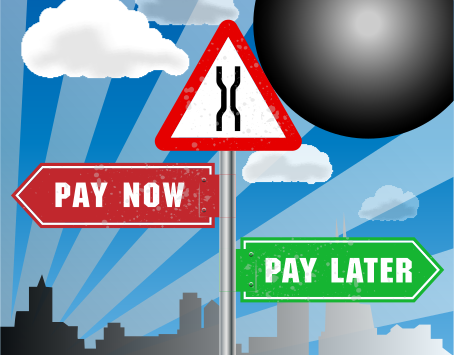
On 2 February 2021, the UK government announced that it would regulate interest-free buy now, pay later (BNPL) products. It was responding to a clamour for intervention, including from the Woolard Review, which saw “a significant potential consumer harm” in BNPL.
A big reason for the loud complaints was the lack of rules. BNPL is unregulated in the UK. Unlike credit cards and loans, which are tightly bound by laws and supervised by the Financial Conduct Authority (FCA), BNPL providers make use of an exemption for short-term, interest-free credit that was designed to allow staggered payment for items such as doorstep milk delivery or sports club membership fees.
Merchants pay for BNPL to attract customers. If consumers keep up with the scheduled payments, there are no credit fees. That makes it “significantly cheaper than most alternative forms of regulated credit”, as the Woolard Review points out. But it can cause problems for those who don’t, or can’t, make the payments.
The UK government promised action. “People should be able to access affordable credit, but with clear protections in place,” said Andrew Griffith, Financial Services Minister. In February this year, the Treasury launched a public consultation as the first step.
And then came a reversal. In July, it was reported that plans to regulate BNPL had been put on hold. No new rules for the industry. But why?
First, there is the scale of the problem. BNPL is huge. Nearly 40% of British adults use BNPL when shopping online, according to credit agency TransUnion, and 60% of younger shoppers. A quarter of respondents had missed a deadline at some point. BNPL is also attracting more users as households come under financial pressure. Online retailers routinely place BNPL at the checkout. It’s rare not to be offered the choice and on some websites it’s a default option.
The market is brimming with major providers, such as Klarna, DivideBuy, Clearpay, Zilch and Scalapay. Worryingly, not all cooperate with the credit bureaux, led by Experian, Equifax and TransUnion. This means someone with problem debts can accumulate further credit – not a desirable state of affairs.
When the government first looked at regulating BNPL in 2021, interest rates were at 0.1% and inflation was muted. Now that many households are struggling, the case for regulation seems irrefutable. Labour MP Stella Creasy, who is campaigning for tighter regulation, says: “For years, we have been warning of the dangers of BNPL credit, and the need to act before these legal loan sharks become the next Wonga-style scandal. This data again shows why the government’s refusal to regulate them is inexcusable.”
Klarna is both calling for regulation and launching initiatives to raise standards in the industry
Is it inexcusable?
Is it inexcusable?
Alas, so far, government commentary on its thinking has been offered only off-the-record. The unofficial government line is that regulation could hamper innovation in this fast-moving sector. Consumers need credit during hard times, is another line. Interest-free credit provided by BNPL is arguably preferable to borrowing on credit cards, with lower charges and lower default rates. Regulation could push consumers back onto plastic – an own goal. Furthermore, the industry is working hard to outpace regulation.
Klarna, by far the biggest name in the industry, is both calling for regulation and launching initiatives to raise standards in the industry – a sort of self-policing. It wants the information consumers are given when they sign up to be standardised, credit checks to be mandatory and consumers to be able to refer complaints to the Financial Ombudsman.
“We believe regulation is so important,” says Luke Seaman, Head of Public Affairs at Klarna UK. “It will be kill or cure for providers that don’t have our ethos. They’ll either have to get up to our standard or exit the market. If they exit, that can only be good for consumers.”
In terms of action, “we’ve made our terms and conditions clearer,” he says. “We introduced an internal complaints adjudicator to replicate some of the functions of the Financial Ombudsman service. We give customers an opt-out tool and want to make sure we are the standard bearer for the industry.”
Klarna already shares information with the credit reference agencies. It runs real-time affordability checks unlike credit card providers, which offer a loan facility based on a one-time assessment.
Klarna is a bank, and as such is regulated wherever it operates. “It just so happens we are also the UK’s largest provider of unregulated products, buy now, pay later. So we are set up to work to a regulated standard,” says Seaman. Klarna says the result is a BNPL default rate of less than 1%, which is 40% lower than on credit cards.
It’s also true that the underlying mechanics used by BNPL providers are improving. Irresponsible lending will be curtailed not just due to regulation, but because the technology is getting better. Provenir, for example, a provider of software for lenders, is working with Zilch in the UK. It pools data sources and then uses artificial intelligence to offer lenders the broadest possible view on the likelihood of default.
“We have over 100 data providers,” says Corinne Lleti, Director-General of Southern Europe, for Provenir. “Open Banking is valuable. We can see someone’s income and their type of outgoings.” Open Banking is the protocol that allows third-parties, with permission, to access the consumer’s bank account records. It offers an instant snapshot of their financial position in real time.
Artificial intelligence and machine-learning allows Provenir and lenders to analyse and weigh collective data sources. Patterns in non-payment can be identified to improve credit scores continuously.
Regulation should not be a knee-jerk reaction. Wholesale change of regulation feels like a potentially risky prospect
Social media play a role in identity checks. “We can do social media accounts,” says Lleti. “Does the person have a Facebook account? Airbnb? Do they have a LinkedIn page or Instagram? How long have these accounts been setup for? We can start to see if they are a genuine person or a fake.”
She says better use of technology allows the expansion of credit, without the expansion of risk. “One of the things buy now, pay later has done is push the frontiers of who is creditworthy. Before there was a core population who could get credit. The use of alternative data has brought credit to new people.”
Thomas Eyre, Co-Founder and Co-Chief Executive of Loqbox, which helps consumers build their credit score and provides financial education, says the issue of regulation is a tough one to call. “Regulation should not be a knee-jerk reaction,” he says. “Wholesale change of regulation …feels like a potentially risky prospect.”
He says the market is already reacting to market forces: “We’re already seeing the consequences for lenders with unsustainable business models – they’re downsizing, pulling out of markets, or going out of business altogether. This has as much to do with the funding and capital markets as it does with consumer use.”
Share of UK households using BNPL by housing tenure
Share of UK households using BNPL by housing tenure
Source: Shining Light on ‘Shadow Credit’ – what is buy now, pay later and who uses it?, by Bank Underground, August 2023
This process is doing what regulation might already be attempting to achieve. “Expect to see many of these players exiting the market as quickly as they arrived,” Eyre says. “Consolidation of the market is likely to lead to better consumer outcomes, even if that outcome is a reduction in access to unsustainably cheap or free credit.”
So there is cause for optimism. The providers want regulation. The market is consolidating. Better technology is improving credit decisions. And providers are competing on virtuous behaviour, launching consumer help schemes and sharing information with credit bureaux well before regulation demands it.
The government may yet regulate. But the real pressure to act could come down to higher interest rates and steep inflation. As the number of consumers who use BNPL increases, so the risk to the industry of being labelled a menace rises. It is better to be the good guys who rally round to help consumers through tough times than follow companies like Wonga into oblivion.
Charles Orton-Jones
Charles Orton-Jones is the founder and Editor of Business Age, and a winner of the Professional Publishers Association (PPA) Business Journalist of the Year category. He is currently an e-resident and digital nomad visa holder of Estonia
More from
Features